Classic Literature
Which translation of The Three Musketeers should you read?
Pevear’s complete modern text against the Victorian translation in its annotated Oxford and budget Wordsworth editions
By Jenny Eich23 November 20262 min read3 books
This site earns from qualifying purchases as an Amazon Associate and Bookshop.org affiliate, at no extra cost to you. Every book here was chosen by hand.How this works
The Three Musketeers has a translation question that most readers never notice, because for a century and a half there was effectively one answer. William Barrow translated the novel in 1846, two years after it appeared in Paris, and his text, lightly revised or anonymously reprinted, is what sits inside most paperbacks, school editions and free e-books to this day. It is a good translation of its time. It is also a Victorian one, which means it trims the drinking, dulls the jokes about the Church, and sets d’Artagnan’s speeches in a register no one has spoken for a long while.
Richard Pevear’s 2006 translation changed that. It is complete, it is quick, and it was made by someone who treats Dumas as a writer rather than a children’s author. The comparison here rests on two scenes: the duel behind the Carmelite convent, where the French is comic and fast, and Milady’s imprisonment in England, where it slows into melodrama. The Victorian text is at its best in the second; Pevear wins the first outright.
This guide covers the English question. For the French editions, see the note at the end.
Three editions of The Three Musketeers, and what each gives you| Translator | Edition | Notes? | Best for |
|---|
| Richard Pevear | Penguin Classics, 2007 | Introduction and endnotes | The one to own: complete, fast, modern |
|---|
| William Barrow, 1846, ed. David Coward | Oxford World’s Classics, 2008 | Full notes and chronology | Readers who want the classic text explained |
|---|
| Anonymous, 19th century | Wordsworth Classics, 1993 | Brief introduction | The cheapest way in |
|---|
Each row links to its entry below.
The books
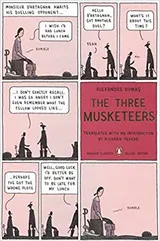
Pevear, best known for the Russian novels he translates with Larissa Volokhonsky, went to Dumas alone and produced the first complete English text in a century and a half, restoring passages the Victorians softened and giving the dialogue the snap of a stage comedy. The Penguin Classics edition has a short introduction and notes that stay out of the way. Ideal for a first reading and for anyone who found the old translation stiff.
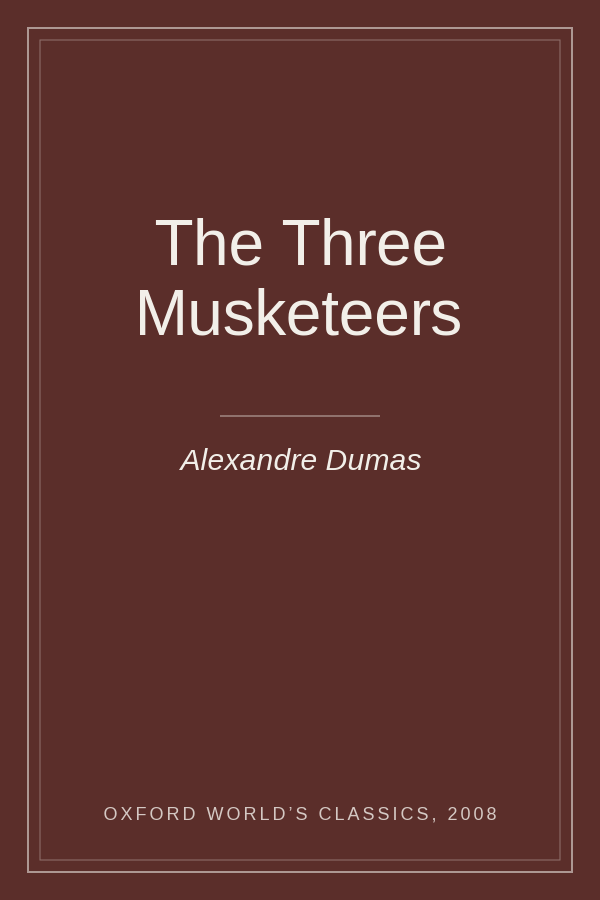
02.02. The Three Musketeers, William Barrow’s 1846 translation, Oxford World’s Classics
Alexandre Dumas (1844)
William Barrow’s 1846 translation, edited with notes by David Coward, Oxford World’s Classics, 2008
Barrow’s translation of 1846 is the one most English readers have met without knowing it, and David Coward’s Oxford edition presents it honestly: a chronology, an introduction on Dumas and his collaborator Maquet, and notes that explain the history the novel bends. The prose is Victorian but brisk, and the book is a handsome paperback. Ideal for readers who like their classics annotated, and for anyone studying the novel.
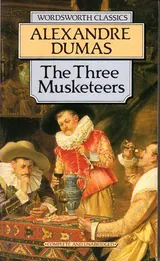
The Wordsworth paperback carries a nineteenth-century translation with a short introduction and nothing else, at a price that makes it the usual school and holiday copy. The text reads fine; the paper and type are what you pay for. Ideal for readers on a budget or buying a copy to lend, who will not miss the notes.
Buy Pevear for the novel as Dumas wrote it, in English that moves. Buy the Oxford if you want the Victorian text with its history explained. The Wordsworth is the right answer only when price decides. Whichever you choose, the sequel question comes next: Twenty Years After and The Vicomte de Bragelonne continue the story, and the Oxford World’s Classics set is the only one that carries all of them in matching editions.
Questions readers ask
Is The Three Musketeers hard to read?
No. It is a fast adventure novel written for serial publication, with short chapters and a cliffhanger at the end of most of them. The 1846 translation sounds old-fashioned in places; Pevear’s does not.
Do I need to read the sequels?
The novel ends completely on its own. Twenty Years After and The Vicomte de Bragelonne, which contains The Man in the Iron Mask, continue the characters’ lives but are separate books.
Which translation is in the free e-book editions?
The public-domain e-books carry the 1846 Barrow translation or another nineteenth-century text, without notes. The Oxford edition is the same translation with the scholarship added.